Your business is already using AI. But who’s controlling it?
There are practical opportunities across research, writing, reporting, software development and everyday administration. AI can help people explore ideas, work through problems and get useful work underway. We want our customers to benefit from that.
AI, Security
There are practical opportunities across research, writing, reporting, software development and everyday administration. AI can help people explore ideas, work through problems and get useful work underway. We want our customers to benefit from that.
We also believe businesses should have control over how their information and resources are used.
That means knowing which AI tools people are using, keeping work within approved accounts, setting boundaries around sensitive information, and being able to see whether those boundaries are working.
Our AI Governance service gives businesses practical controls to support those decisions.
The right tools, using the right accounts
Approving an AI product is only part of the decision. The account someone uses matters too.
A business might approve ChatGPT or Claude for work, with a company-managed account and agreed settings. Someone using the same product through a personal account may be operating outside that arrangement.
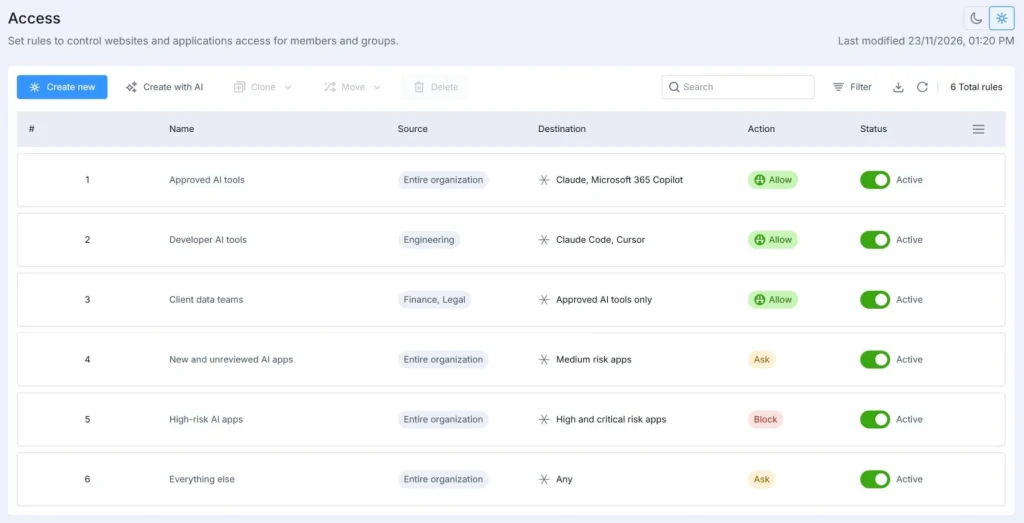
On supported platforms, we can distinguish between approved business accounts and personal or unmanaged accounts, then apply the appropriate rules.
Those rules can vary by person or team. Developers might need coding assistants, while another department needs a smaller set of approved tools. New services can be assessed before being made available more widely.
That gives staff a clear understanding of what they can use and gives the business a way to enforce those decisions.
Control the information going into AI
The information someone submits deserves just as much attention as the tool itself.
Think about the difference between asking AI to improve a general announcement and uploading a payroll spreadsheet. Both might feel like ordinary productivity tasks to the person doing them, but the information involved is very different.
We can configure checks around prompts, pasted text and file uploads, using rules for financial information, personal information and other sensitive business content.
When a rule matches, the action can be blocked. In supported prompt interactions, sensitive details can be removed before the remaining text is submitted. Other situations can require the person to confirm what they are doing and provide a reason before proceeding.
The response depends on the rule you have agreed.
We also work through how those rules should align with your existing information classifications, sensitivity labels and data protection requirements.
Rules that fit how your business works
The configuration needs to reflect the organisation using it.
Different teams handle different information and need different tools. A rule that makes sense for finance may need to be different from one used by a development team.
Access conditions matter as well. For example, a business might want a particular paid AI service available only from an approved office location. We can assess those requirements alongside the account, device and network controls needed to support them.
The starting point is understanding what people need to do, then agreeing the conditions under which that use is appropriate.
Detailed reporting gives management a clearer picture
Reporting is a substantial part of this service.
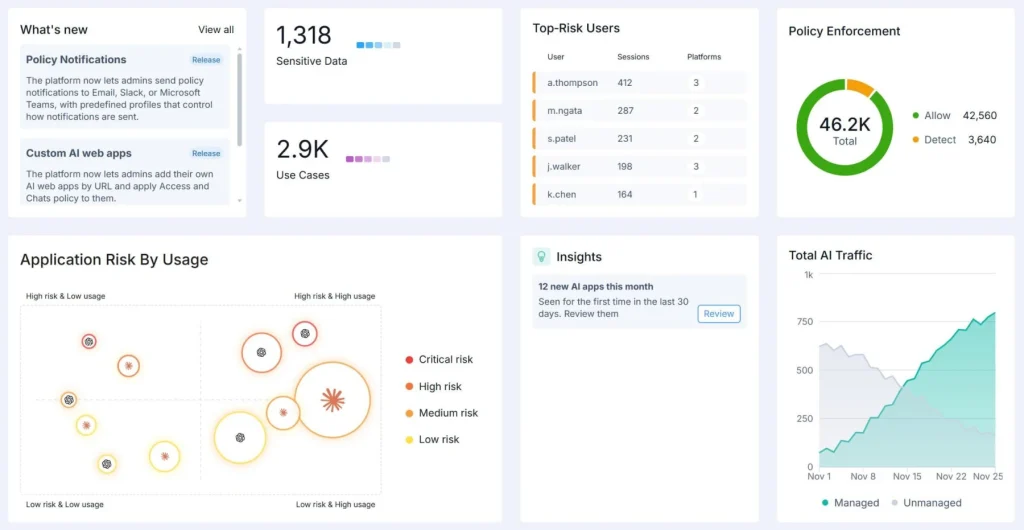
Management needs to understand what is happening across the environment and whether the rules are working. The reporting can show:
Which AI applications are being used, by whom, and the types of work associated with that activity.
Whether activity involves approved business accounts or unmanaged accounts.
Where sensitive information has been detected.
Which actions were allowed, blocked, redacted or required confirmation, including recorded justifications where applicable.
That information helps the business make better decisions.
If a particular tool is becoming popular, there may be a useful business case for formally approving it. Repeated sensitive-data events may show where staff need guidance or where a workflow needs changing. A rule that regularly interrupts legitimate work may need refinement.
The same records can support discussions with leadership, boards and auditors about how the organisation’s AI policy is being applied.
We also agree what information is retained, who can review it and how long it is kept. Staff should understand what is monitored and why.
A managed service that develops with you
Layer3 AI Governance is available as an add-on to our managed services.
We start with discovery so we can understand the AI already in use. From there, we work with you to agree approved tools, account requirements, sensitive-data rules and the decisions that need ongoing review.
The controls apply to supported applications on managed devices where the required components are installed. Unmanaged personal devices remain outside that coverage, which is why a clear policy and staff training are still part of the work.
People also remain responsible for checking AI outputs and making decisions appropriate to their role.
As your use of AI develops, the rules and reporting need to develop with it. We manage that ongoing process with you.
I want businesses to explore what AI can do for them. I also want the people running those businesses to feel confident about how it is being used.
Knowing which tools are approved, what information can be shared and how activity is reviewed gives everyone a clearer basis for moving forward.
If you want to understand what AI is already being used in your business, and what sensible controls could look like,talk to Layer3 about AI Governance.